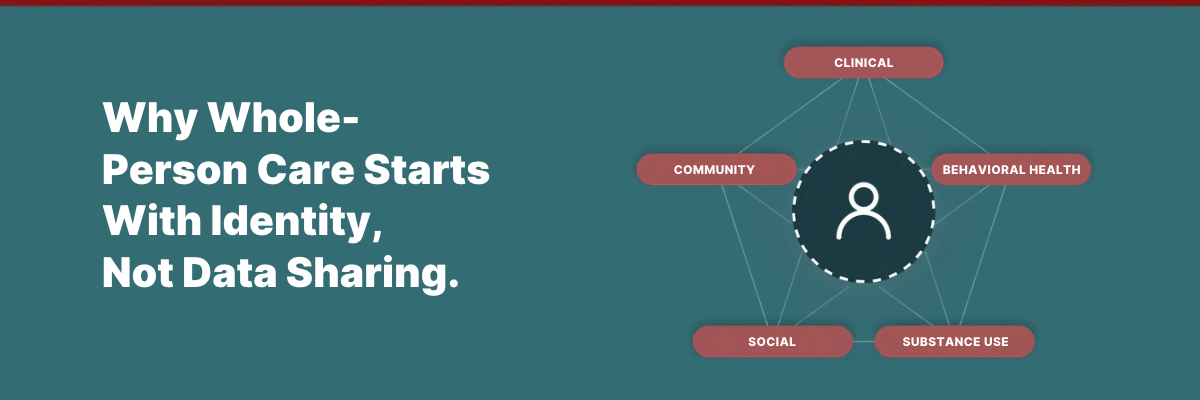
Why Whole-Person Care Starts With Identity, Not Data Sharing
Everyone in healthcare is talking about data sharing. Health information exchanges, community information exchanges, national networks, care coordination platforms. The goal is right. Care that accounts for the whole person, medical, behavioral, substance use and social determinants of health (SDoH), is better care.
But there’s a piece missing from most of those conversations. Before any of that data can help someone, the system has to know who that someone is. Connecting data isn’t enough. True whole-person care starts with identity.
Connecting data isn’t the same as knowing the person
Data sharing answers one question: can information move from one organization to another? Identity answers a harder one: does the information belong to the person it is attributed to?
When identity is fragmented, the whole-person view falls apart. A patient’s primary care history lives on one record, their behavioral health visits on another, and the community organization that helped them last winter knows them by a nickname. Every system is connected, and no one sees the whole person. Or worse, two people are merged into one record, and a care team makes decisions using someone else’s history.
That’s why patient identity is the foundation of every data initiative. In whole-person care, it matters even more.
Whole-person care makes identity harder, not easier
Whole-person care brings together organizations that have never shared a system: hospitals, behavioral health providers, substance use programs, housing services and community organizations. Each one collects information differently, and many were never built around the details patient matching depends on.
Every new source adds more variation, and more chances for one person to become several records. The people who benefit most from whole-person care, often those with complex, co-occurring health and social needs, can also be the hardest to match.
It’s why identity resolution sits at the core of the Chicago Regionwide Community Information Exchange, where 4medica provides the data-sharing infrastructure connecting health, social service and community organizations. Without it, a region wide network would just be a faster way to scatter one person’s story across more systems.
Consent only works if it’s tied to the right person
Whole-person care means handling some of the most sensitive information in healthcare, including behavioral health and substance use records protected under HIPAA and 42 CFR Part 2. Consent is how patients decide who sees that information.
But a consent decision is only as good as the record it’s attached to. If a patient’s consent sits on a duplicate record, their care team may not see information the patient agreed to share. If two people are merged, one person’s substance use history can surface in front of the wrong care team. That’s not just a compliance problem. For the person involved, it can mean stigma, broken trust, and a reason never to come back for care.
Identity is a person, not a record
It’s easy to talk about identity as a data problem. It isn’t. Every record represents a real person, often someone at one of the hardest points in their life, and they deserve to be treated with the highest level of regard by every system trying to help them.
When identity breaks, the consequences are personal and can even be dangerous. A missed allergy or medication. A substance use history that never reaches the emergency physician. A referral for housing or food that lands on a duplicate record and is never followed up. Too many people are forced to repeat their stories, and relive their trauma – every time they meet a new provider.
Identity errors show up downstream
Identity problems rarely look like identity problems when they surface. They’re created upstream, at a registration desk, an intake form or a community check-in – and increasingly they are being exacerbated by the use of AI. They show up downstream as a missed referral, a consent that can’t be found, a care manager chasing the wrong record, or a clinician working with half a history.
By the time anyone notices, the error has already traveled through every connected system. More data sharing without a resolved identity doesn’t fix that. It spreads it further, faster.
What whole-person care built on identity looks like
The hard part of whole-person care isn’t wanting it. It’s doing it. Data is siloed. Consent is complicated. Systems don’t talk to each other. And none of that gets solved by adding another point solution. It gets solved by fixing the foundation.
That starts with identity. Every consent decision, every data exchange and every care team handoff only works if it’s tied to the right person, every time. From there, whole-person visibility means:
- Seeing clinical and community data together, not in separate systems, through a unified clinical viewer.
- Connecting clinical, behavioral and community providers in real time through a shared care team network.
- Managing consent in a way that actually satisfies HIPAA and 42 CFR Part 2, with consent management tied to the right person.
- Bringing social needs into the same view as medical ones, instead of treating them as separate, with an integrated SDoH platform.
Data sharing builds the road. Identity decides whether what travels on that road reaches the right person.
One patient. One record. That’s where whole-person care begins.
See the Power of Whole-Person Data in Action.
Let’s talk about how identity-first data can connect your clinical, behavioral and community partners around the people you serve.
Book a Duplicate Reduction Strategy Session.
A 30-minute working session will help you identify where your duplicate rate really sits, what it’s costing you, and the fastest path to near-perfect.